Betfair UFC Odds: How the Exchange Model Creates Better Prices for MMA Bettors
 Available in US
- Exchange Betting Eliminates the Bookmaker Margin — UFC Is No Exception
- Back and Lay Explained for UFC Fights
- UFC Liquidity on Betfair: When Markets Get Deep Enough to Trade
- Betfair Commission vs Bookmaker Margin: The True Cost Comparison
- When to Use Betfair Exchange and When to Stick with a Traditional Bookmaker
- Frequently Asked Questions
Exchange Betting Eliminates the Bookmaker Margin — UFC Is No Exception
The first time I placed a UFC bet on Betfair Exchange, the odds were 15% better than the best fixed-odds price I could find anywhere else. That’s not an exaggeration or a cherry-picked example — it’s a structural feature of how exchanges work. When you remove the bookmaker from the equation and let bettors trade directly against each other, the built-in margin evaporates.
MMA betting handle in the US alone reached $10.3 billion in 2024, and that growing volume has spilled into exchange markets too, making Betfair increasingly viable for UFC. But the exchange model comes with trade-offs that every punter needs to understand before assuming it’s automatically superior to traditional bookmakers.
I use Betfair selectively — for specific fight types and specific situations — and this guide explains exactly when the exchange earns its place in your UFC betting rotation and when a conventional bookmaker serves you better.
See also: explore betting on ufc fights for the latest UFC wagering insights.
Back and Lay Explained for UFC Fights
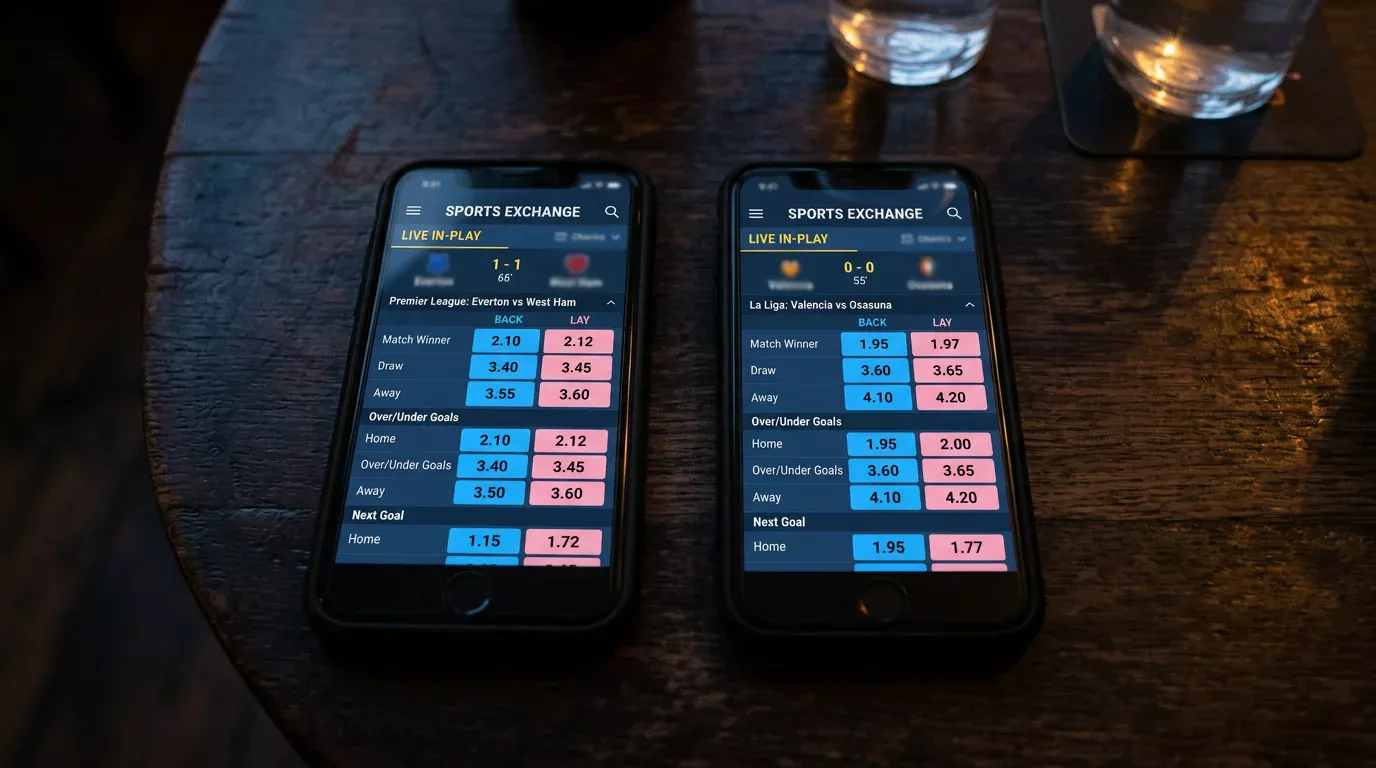
At a traditional bookmaker, you can only back a fighter — bet that they’ll win. On an exchange, you can also lay a fighter — bet that they’ll lose. This is a fundamental shift in how betting works, and it opens strategies that simply don’t exist in the fixed-odds world.
Backing on the exchange works identically to a normal bet. You see a price, you stake your money, and if your fighter wins, you collect. The difference is that your opponent in this transaction isn’t a bookmaker — it’s another bettor who believes the opposite. Because neither of you needs to build in a profit margin, the odds are set purely by supply and demand.
Laying is the mirror image. When you lay a fighter at 3.00, you’re saying “I don’t think this fighter will win, and I’m willing to pay out at 3.00 if they do.” Your liability is the potential payout minus the backer’s stake. If someone backs 10 pounds at 3.00, your liability is 20 pounds (the 30-pound total payout minus the 10-pound stake that came from the backer). If the fighter loses, you keep the backer’s 10-pound stake as profit.
For UFC, laying opens a valuable angle: if you believe a heavy favourite is overpriced but don’t want to commit to backing the underdog (because underdogs carry their own risk), you can lay the favourite. If the favourite loses by any method — knockout, submission, decision — your lay wins. It’s a way to express a negative opinion without needing to pick the specific beneficiary of that opinion, which in a two-fighter contest amounts to the same thing, but psychologically and analytically feels different in a way that sharpens my thinking.
UFC Liquidity on Betfair: When Markets Get Deep Enough to Trade
Liquidity is the exchange’s Achilles heel for UFC betting, and pretending otherwise would be dishonest. With over 290 million online bets placed monthly in the UK across all sports, there’s plenty of money in the system — but UFC doesn’t attract the same exchange activity as football or horse racing.
On numbered UFC events, main event and co-main event markets typically have enough liquidity to get a meaningful bet matched at competitive odds. I’m talking tens of thousands of pounds available within a tick or two of the best price. That’s sufficient for any recreational bettor and most semi-professionals. The quality of these prices, when liquidity exists, is genuinely better than fixed-odds alternatives — I’ve seen main event moneylines where the exchange overround is below 1.5%, compared to 3-4% at traditional bookmakers.
The problem begins on undercards. Preliminary card fights on Betfair Exchange often have minimal liquidity — sometimes just a few hundred pounds available, and sometimes at prices that are worse than the fixed-odds alternatives because the market is too thin for efficient price discovery. Fight Night events are worse again, with only the main event consistently trading with reasonable depth.
Liquidity also builds over time. A market that shows only 500 pounds available on Monday might have 5,000 by Friday evening and 15,000 by fight night. If you’re planning to use the exchange, checking liquidity on the day of the event rather than at the start of fight week gives a far more accurate picture of what’s achievable.
Betfair Commission vs Bookmaker Margin: The True Cost Comparison
Betfair charges commission on net winnings, not on every bet. The standard rate is 5%, though high-volume users can negotiate lower rates. This means if you win 100 pounds on a UFC bet, Betfair takes 5 pounds, and you keep 95. If you lose, you pay nothing beyond your lost stake.
Compare that to the bookmaker margin model. A traditional bookmaker with a 4% overround on a UFC fight takes their cut upfront, embedded in the odds — you pay it whether you win or lose. Over a large sample of bets, the effective cost depends on your strike rate. For a bettor who wins 50% of their bets at average odds of 2.00, the commission model and the margin model produce similar costs. But for a bettor who wins less frequently at higher odds — which is the profile of a value bettor targeting underdogs — the commission model is significantly cheaper because you’re only paying when you actually profit.
I’ve calculated the effective cost difference across my own UFC betting history, and the exchange saves me roughly 1.5-2% on an annualised basis compared to fixed-odds markets. That sounds small, but on a yearly staking volume in the thousands, it compounds into meaningful money — and in a market where edges are narrow, every fraction of a percentage matters.
When to Use Betfair Exchange and When to Stick with a Traditional Bookmaker
My rule is straightforward. Main event moneylines on numbered UFC events: check Betfair first. If the liquidity is there and the price is better than fixed-odds alternatives, use the exchange. Everything else — undercards, prop bets, round betting, Fight Night events — default to a traditional bookmaker where market depth and breadth are guaranteed regardless of how much other money is in the market.
See also: compare platforms with our Bet365 UFC betting review.
There’s one exception. If I want to lay a fighter rather than back their opponent, the exchange is the only realistic option. Traditional bookmakers don’t offer lay betting, and while the mathematical outcome is identical to backing the other fighter in a two-way market, the exchange sometimes offers a better effective price on the lay side than the back side of the opponent, because different bettors are active in each direction.
For a comparison of how traditional bookmakers stack up against each other for UFC markets, the bet365 analysis covers margins and market depth in detail. The short version: use both. The exchange for main events where liquidity rewards you, and a fixed-odds bookmaker for everything else. Treating them as complementary tools rather than competing alternatives is how I extract the most value from UFC betting across a full calendar year.
Frequently Asked Questions
Is there enough liquidity on Betfair Exchange for UFC Fight Night events?
For most Fight Night events, only the main event has sufficient liquidity for competitive exchange betting. Undercard fights typically have minimal money available, often at prices worse than fixed-odds bookmakers. If you want to use the exchange for Fight Nights, check liquidity on the day of the event and be prepared to use a traditional bookmaker as a fallback.
Can I lay a UFC favourite on Betfair and profit if they lose?
Yes, laying a favourite is a core exchange function. When you lay a fighter, you profit if they lose by any method. Your liability is the potential payout minus the backer’s stake, so laying a heavy favourite at short odds carries lower liability than laying at longer prices. This is a useful strategy when you believe a favourite is overpriced but don’t have strong conviction about which specific underdog will win.
Written by the editors at Betting on ufc Fights.