Live UFC Betting: How In-Play Odds Move and When to Strike
 Available in US

- Why Live Betting on UFC Fights Is a Different Game Entirely
- How In-Play UFC Odds Are Calculated and Updated
- Between-Round Windows: Where the Biggest Odds Swings Happen
- Reading Momentum Shifts Inside a Fight
- When Bookmakers Overreact: Knockdown Panic and Recovery Fighters
- Cash Out During UFC Fights: When It Makes Mathematical Sense
- Which In-Play Markets Are Available for UFC at UK Bookmakers
- Latency, Streaming Delay, and Practical Limits of Live UFC Betting
- Frequently Asked Questions
Why Live Betting on UFC Fights Is a Different Game Entirely
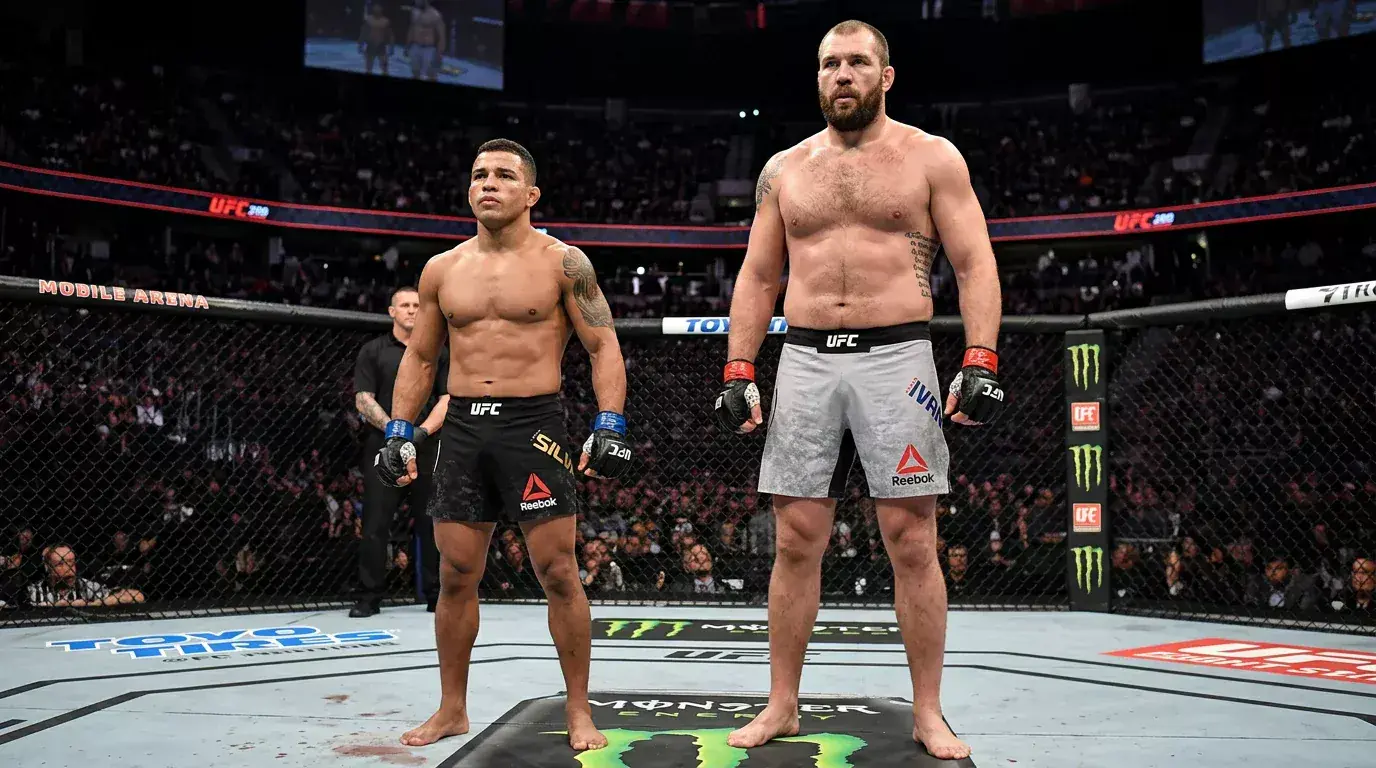
Round one is over. Fighter A, the pre-fight favourite at 1.45, has just been taken down twice and controlled on the mat for three minutes. The horn sounds. Between rounds, the bookmaker’s algorithm recalculates. By the time round two begins, Fighter A’s live price has drifted to 2.10. The implied probability has shifted from 69% to 48% in sixty seconds. That shift — if you saw it coming because you understand how takedown control affects in-play pricing — was a betting opportunity with a window measured in moments, not minutes.
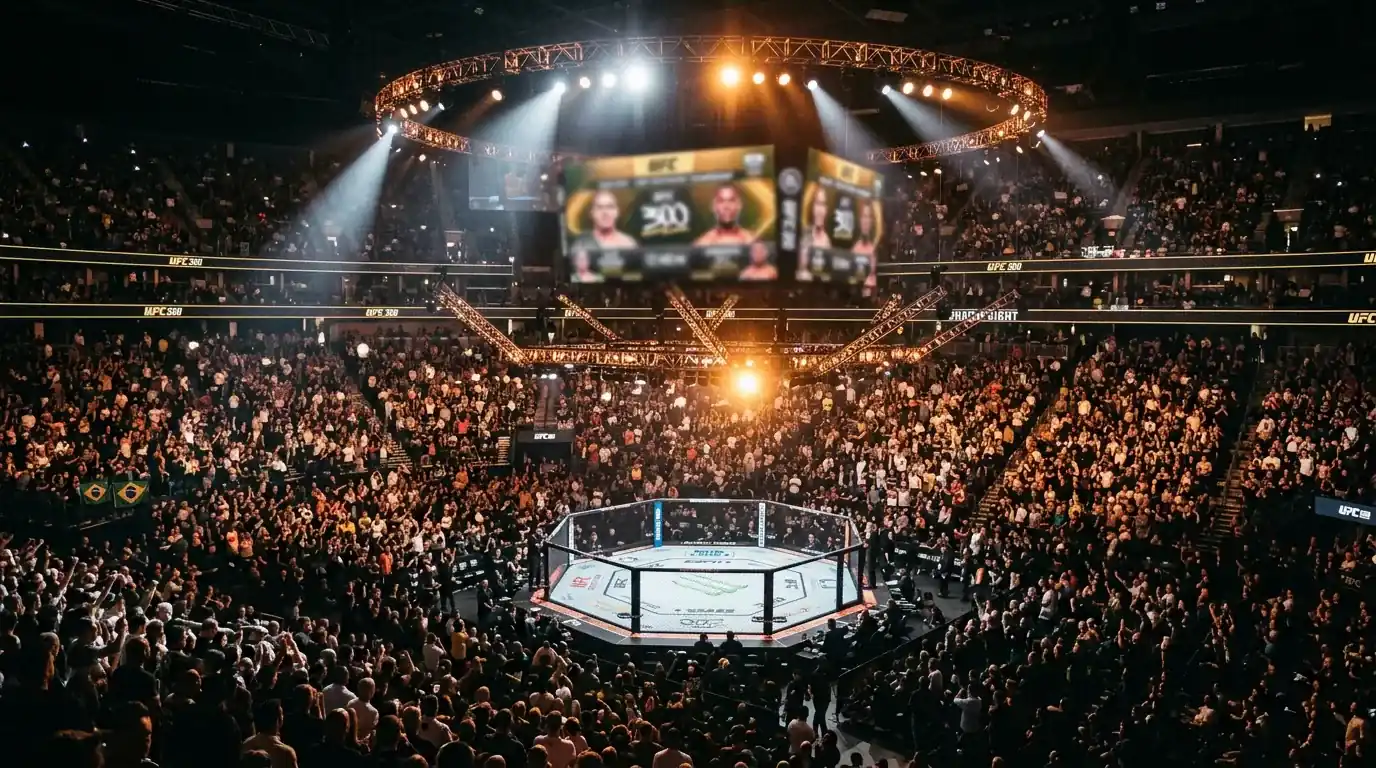
Live UFC betting is a fundamentally different discipline from pre-fight betting. The analysis changes, the tempo changes, and the margin for execution error shrinks to almost nothing. UFC generated $1.4 billion in total revenue in 2024 and commands a global fanbase of over 700 million, and an increasing share of the betting volume on those events flows through in-play markets where prices react in real time to what is happening inside the octagon.
This guide covers the mechanics of how live UFC odds are set and updated, where the biggest price dislocations occur, and — practically — how a UK punter can exploit those dislocations before they close. Pre-fight betting rewards research and patience. Live betting rewards speed, pattern recognition, and the ability to act on incomplete information while everyone else is still processing what just happened. The two disciplines complement each other, but they require different skills, different preparation, and a different relationship with uncertainty.
See also: head to betting on ufc fights for essential UFC wagering tools.
How In-Play UFC Odds Are Calculated and Updated
Before a single punch is thrown, the bookmaker’s in-play model has already pre-loaded a set of scenarios. It knows how the odds should move if Fighter A wins round one on the scorecards. It knows how they should move if Fighter B scores a knockdown. It has a price path for almost every plausible in-fight event, calibrated by the pre-fight odds and the historical frequency of each scenario across thousands of prior UFC bouts.
Trip Stoddard at bet365 described the operator’s positioning as built around “sports where live action and fan engagement are inseparable” — and that inseparability is the engine of live UFC pricing. The model takes the pre-fight probability, adjusts it in real time based on what happens during the fight, and outputs a new price after each significant event: a knockdown, a takedown, a round ending, a visible cut, a doctor’s check.
The critical thing to understand is that live odds are not opinions. They are algorithmic outputs. The model processes events and produces prices according to rules. Those rules are sophisticated but not omniscient. They handle common scenarios well — a fighter who wins a dominant round sees their price shorten predictably. But they handle uncommon scenarios less precisely — a fighter who absorbs a huge shot but visibly recovers and starts pressing forward may see their price lengthen more than the in-fight dynamics justify, because the model weights the “huge shot” more heavily than the “visible recovery.”
That gap between what the algorithm calculates and what your eyes tell you is the entire basis for live UFC betting edge. The model processes data points. You process context. When those two assessments diverge, one of you is wrong — and the bettor who has spent years watching fights has a contextual advantage that no algorithm fully replicates. The algorithm does not see a fighter wince when putting weight on their left leg between exchanges. You do. The algorithm does not notice that a corner’s body language has shifted from composed to frantic. You do. These contextual signals are the raw material of live betting edge, and they are invisible to every pricing model currently in use.
Between-Round Windows: Where the Biggest Odds Swings Happen
I have placed more profitable live UFC bets in sixty-second between-round windows than in any other context in eleven years of betting on this sport. The reason is structural: the between-round break is the single moment when the most information enters the market simultaneously and the algorithm has to reprice everything at once.
Here is what happens. The horn sounds ending a round. Within seconds, the bookmaker’s model ingests the round’s data — striking totals, control time, knockdowns, submission attempts, round winner assessment. It recalculates the fight winner probability and outputs new odds. Those odds appear on your screen. At that exact moment, you have information the model does not fully weight: body language in the corner, the fighter’s breathing rate, whether the cut man is working on a wound, whether the coach’s instructions suggest a tactical change or desperation. These contextual signals take the model several seconds to partially incorporate through money flow as other sharp bettors react.
The UFC runs 43 events per year, and each three-round fight has two between-round windows. A five-round championship bout has four. Across a full card of 12 to 15 fights, you might get 30 or more between-round repricing moments in a single evening. Not all of them produce exploitable dislocations. But on a typical card, I find two to four windows where the repriced odds meaningfully diverge from my in-fight assessment. Those are the moments I bet.
The execution requirement is demanding. You need to have the bookmaker’s app open, the fight’s live market loaded, and your analysis framework already running in your head before the round ends. When the horn sounds, you have roughly 30 to 45 seconds to see the new price, compare it to your assessment, decide, and place the bet. Hesitation costs money — either because the price moves toward fair value as the market adjusts, or because the next round begins and the betting window closes entirely.
Reading Momentum Shifts Inside a Fight
Momentum in a UFC fight is real, visible, and consistently mispriced by live betting algorithms. A fighter who loses the first round but lands a hard shot in the final thirty seconds of round two is carrying momentum into round three — and the in-play model, which primarily weighs round-level outcomes, does not fully capture the within-round trend that your eyes can see.
Reading momentum requires watching the fight, not just tracking the score. A 10-9 round on the scorecards tells you who won the round. It does not tell you whether the losing fighter was hurt and surviving or fresh and building. A fighter who lost round one 10-9 but spent the final minute pressing forward and landing cleaner shots is in a fundamentally different position than one who lost 10-9 while retreating and absorbing damage. The scorecards do not differentiate. The momentum does. And the live odds — which react primarily to the scorecard — leave room for you to bet on the momentum.
There are specific momentum patterns I watch for. The first is the late-round surge: a fighter who visibly increases output in the final minute of a round they are losing. This signals cardio reserves and tactical adjustment, both of which carry into the next round. The second is the grappling transition: a fighter who was being outstruck on the feet starts finding takedowns or clinch control, indicating a style shift the opponent has not yet solved. The third is the body attack: sustained body shots that do not register on most scoring systems as heavily as head strikes but accumulate fatigue that manifests in later rounds.
None of these patterns are invisible. Any experienced MMA viewer can spot them. The edge is not in seeing them — it is in acting on them before the market adjusts. That requires having a plan before the fight starts: knowing which momentum signals you are watching for, knowing what price shift they justify, and having the app ready to execute the moment the opportunity appears.
When Bookmakers Overreact: Knockdown Panic and Recovery Fighters
A fighter gets dropped by a clean right hand. The crowd erupts. The live odds on the dropped fighter instantly lengthen from 1.80 to 3.50. Social media explodes with “it’s over” takes. And then — the dropped fighter gets up, clinches, recovers, and goes on to dominate the next two rounds and win by decision. That sequence happens in UFC far more often than the live market prices suggest, and it is one of the most consistently profitable patterns in live MMA betting.
Knockdowns are the single biggest trigger for in-play overreaction. The bookmaker’s model treats a knockdown as a high-significance event — which it is — but it applies a generic severity adjustment that does not distinguish between a flash knockdown where the fighter pops straight back up and a concussive knockdown where the fighter’s legs are visibly compromised. Your eyes can tell the difference. The algorithm, processing the event as a binary “knockdown: yes,” cannot.
Recovery fighters — those with a documented history of absorbing big shots and coming back to win — are particularly valuable in these scenarios. If you know, from your pre-fight research, that a fighter has been dropped before and recovered to win, you can pre-plan a live bet: if they get dropped and the price spikes, you bet the recovery. The pre-planning is essential because the window is short. You cannot start researching a fighter’s chin durability after the knockdown has already happened and the price has already moved.
The inverse also applies. When a heavy favourite scores an early knockdown and their live price shortens to 1.10 or lower, the market has priced in a near-certain finish. If the opponent survives the follow-up and makes it to the end of the round, that 1.10 price suddenly looks too short — the fighter has already shown they can absorb the worst-case scenario and stay in the fight. Laying the favourite or backing the recovering underdog in that between-round window is a position the live market consistently undervalues.
The broader principle behind all of these scenarios is the same: live algorithms overweight dramatic events and underweight contextual recovery signals. Every time you see a price spike that feels too extreme for what actually happened in the octagon, test it against your knowledge of the fighter’s history and the fight’s trajectory. More often than you would expect, the overreaction creates a price that would have been genuinely valuable pre-fight — and it appeared only because of a single flashpoint that the algorithm treated as more decisive than it was.
Cash Out During UFC Fights: When It Makes Mathematical Sense
Cash out is a tool, not a strategy. That distinction matters because most live bettors treat it as a panic button — cashing out when their fighter gets hurt, locking in profit when they are ahead, making decisions driven by fear and greed rather than mathematics. Used correctly, cash out during a live UFC fight is a calculated position adjustment. Used emotionally, it is a consistent source of value leakage.
The mathematics of cash out are simple: every cash out offer from a bookmaker is priced in the bookmaker’s favour. The offered amount will always be less than the theoretical fair value of your position, because the bookmaker applies a margin to the cash out just as they do to the original bet. The question is whether that margin cost is justified by the information you have gained since placing the bet.
A scenario where cashing out makes mathematical sense: you backed Fighter A pre-fight at 3.00 and they dominated round one. Their live price has shortened to 1.60, and the cash out offer is 65% of your potential profit. You now believe, based on what you have seen, that Fighter A’s true probability of winning is around 70% — close to what the live price implies. The remaining edge in holding the bet is thin, and securing 65% of the profit eliminates the risk of a round-two reversal. In this case, cashing out is a rational decision to lock in realised value rather than gambling on a diminished edge.
A scenario where cashing out destroys value: you backed Fighter A at 3.00 and they are losing round one but you believe the fight dynamics are shifting in their favour — body attacks are accumulating, the opponent is breathing heavily, and your pre-fight analysis predicted a late-round finish. The cash out offer reflects the current scoreline, not the momentum shift you have identified. Taking the cash out here is surrendering a position that your analysis says is undervalued by the market. Hold. For a more detailed framework on when holding versus cashing makes mathematical sense across different fight scenarios, the cash out strategy breakdown provides the decision tree.
Which In-Play Markets Are Available for UFC at UK Bookmakers
Not every UFC betting market that exists pre-fight remains available once the fight begins. Understanding which in-play markets your bookmaker offers — and which close at the first bell — determines the range of live positions you can take.
The fight winner market is universally available in-play at all major UK operators. This is the core live market: you bet on who wins, and the price updates between rounds and after significant events. Over/under rounds is the second most commonly available in-play market, though some operators suspend it during the fight and only reopen it between rounds.
Method of victory availability in-play varies. The larger UK operators tend to keep it open between rounds, allowing you to bet on KO/TKO, submission, or decision for each fighter as the fight develops. This is particularly valuable because your in-fight observations — a fighter who is visibly hurt but surviving, suggesting a late stoppage, or a grappler who has abandoned takedowns, suggesting a decision — directly inform method of victory probabilities in ways the pre-fight market could not anticipate.
UFC 326 on CBS drew 2.47 million viewers — the strongest linear TV audience for the sport in a decade — and that kind of viewership drives both casual betting volume and operator investment in live market depth. The trend across major UK bookmakers is toward broader in-play UFC offerings, including round winner bets that settle at the end of each round and fight-specific props that open and close within individual rounds. The direction is clear: live markets are expanding, and the bettor who masters them now is building skills that will become more valuable as the product matures.
Latency, Streaming Delay, and Practical Limits of Live UFC Betting
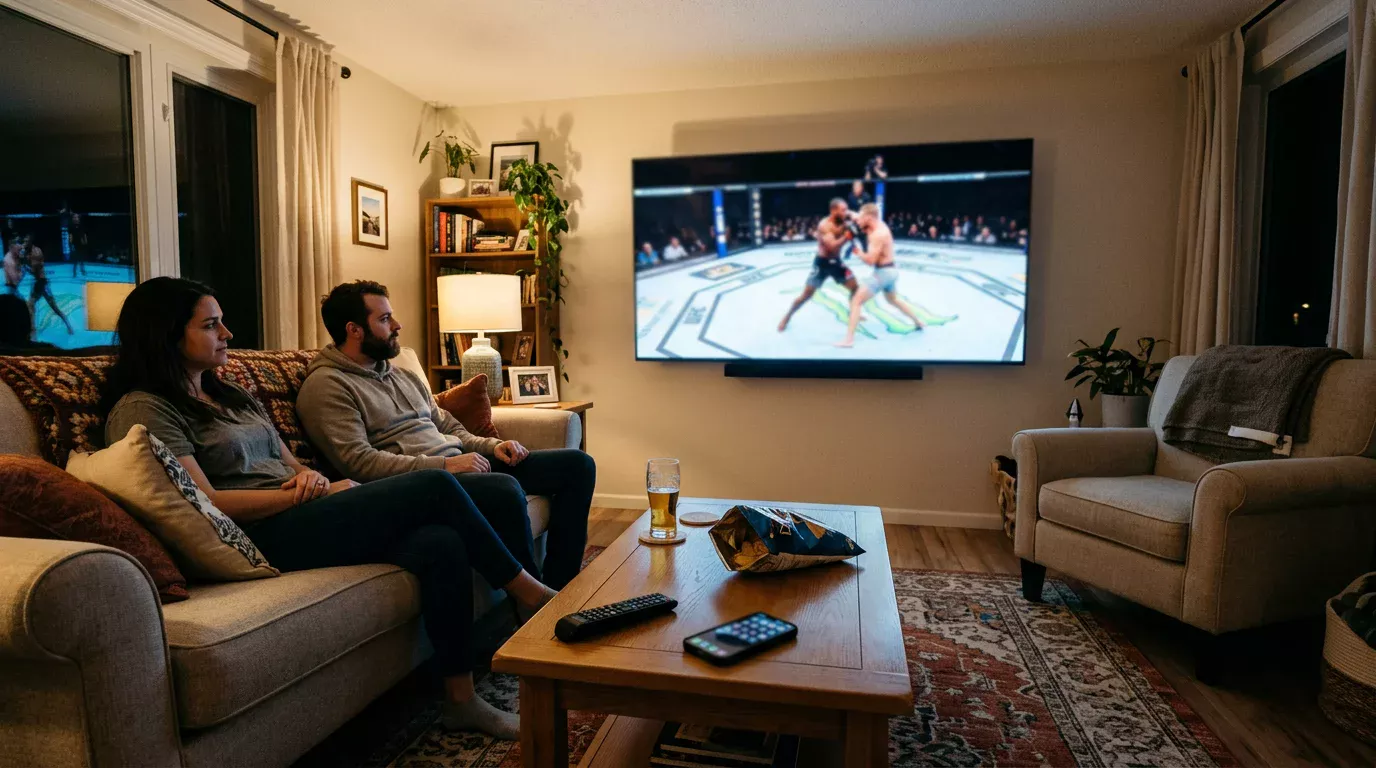
Here is the uncomfortable truth about live UFC betting that no bookmaker will tell you: you are watching on a delay. The broadcast feed you see on your television or streaming device is between 5 and 30 seconds behind the live action in the arena. The bookmaker’s data feed, sourced from in-venue systems, is faster. That asymmetry means the odds on your screen may already reflect an event you have not yet seen.
See also: manage your in-play positions with our UFC cash out strategy guide.
This latency gap has practical consequences. If a knockdown occurs in the arena, the bookmaker’s model begins repricing before the knockdown appears on your screen. By the time you see it, react, and try to place a bet on the recovery, the price has already moved. You are not competing against the bookmaker’s algorithm in real time — you are competing against it on a time delay, which is a structural disadvantage.
The mitigation is to focus on between-round windows rather than mid-round events. Between rounds, the action pauses for sixty seconds. The bookmaker has already repriced based on the completed round. The broadcast delay becomes irrelevant because nothing is happening — the fighters are in their corners, the octagon is static. This is your window. You have the same information the bookmaker has (the round outcome), you have contextual information the model does not fully weight (corner activity, body language, breathing), and you have enough time to process and act. Mid-round events are the bookmaker’s territory. Between-round windows are yours.
One additional practical point: if you are live betting on a mobile app, close every other app on your phone. Background processes, notifications, and memory-heavy applications slow down the betting app’s response time, adding your own device latency on top of the broadcast delay. In a discipline where seconds matter, a phone optimised for speed is not a luxury — it is equipment.
Frequently Asked Questions
How quickly do live UFC odds update between rounds?
At major UK bookmakers, live UFC odds typically reprice within 5 to 15 seconds of the round ending. The algorithm processes the round’s data — striking totals, control time, knockdowns, submission attempts — and outputs new prices before the next round begins. The exact speed varies by operator, and some suspend betting briefly during the recalculation before reopening with updated odds.
Can I place method of victory bets during a live UFC fight?
At the larger UK operators, method of victory markets are generally available between rounds during live UFC events. The prices update to reflect the in-fight action — for example, a fighter who has been taken down repeatedly may see their ‘win by submission’ price shorten as the grappling threat becomes more apparent. Smaller operators may not offer method of victory in-play, so check your bookmaker’s live market range before fight night.
Is live UFC betting available on all UK bookmaker apps?
All major UKGC-licensed bookmakers offer some form of live UFC betting through their mobile apps, but the depth of in-play markets and the quality of the live experience vary significantly. Some operators offer only the fight winner market in-play, while others provide method of victory, round winner, and over/under rounds throughout the fight. Test the app during a live event before committing to it as your primary live betting platform.
What is the best moment to place a live bet during a UFC fight?
The between-round window — the sixty seconds between the end of one round and the start of the next — is the most valuable moment for live UFC betting. During this window, the broadcast delay becomes irrelevant, the bookmaker has repriced based on the completed round, and you have time to process contextual information that the algorithm does not fully capture. Mid-round events carry higher execution risk due to broadcast latency and faster price movement.
Created by the ”Betting on ufc Fights” editorial team.